Partnering with The Nature Conservancy for Resilient Coastlines

CSI Partnerships: The Nature Conservancy
Northeastern University’s (NU) Coastal Sustainability Institute and The Nature Conservancy (TNC) have been actively collaborating in coastal conservation and sustainability science research and practice since 2012. An overarching goal of this agreement is to promote inclusivity, diversity, and equity by advancing the academic and career development of individuals from backgrounds that have been systemically marginalized in marine conservation and scientific communities.
Northeastern University is a global leader in experiential education and research with CSI-driven expertise in marine and coastal ecology, engineering, environmental forecasting, fisheries, ecosystem-based management, ecological restoration, environmental sociology, and sustainability science. The Nature Conservancy is a world leading conservation organization with priorities currently focused on tackling climate change, protecting land and water, providing food and water sustainably, and building healthy cities. The TNC-CSI Partnership leverages these strengths to foster community-centered solutions via:
- Nature-based Strategies for Coastal Protection
- Climate Change Adaptation & Hazard Resilience
- Sustainable Fisheries & Aquaculture
- Coastal Habitat Conservation & Restoration
CSI-TNC collaborations have already brought in more than $3.35 million in research funds engaging more than 25 TNC Scientists, CSI Faculty, Postdoctoral researchers, and students.
Selected Recent TNC – CSI Publications
Alemu I, J.B., Ofsthun, C., Medley, G., Bowden, A., Cammett, A., Gildesgame, E., Munoz, S.E., Stubbins, A., & Hughes, A.R. Towards an improved understanding of the magnitude and drivers of carbon and nitrogen storage and accumulation in urban saltmarshes: a case study from New England (USA). Urban Ecosyst 29, 84 (2026). https://doi.org/10.1007/s11252-026-01952-2
This study examines the capacity of urban salt marshes in New England to store and accumulate carbon and nitrogen, investigating the factors driving these processes in urban coastal environments. The findings contribute to a broader understanding of how urban wetlands function as carbon sinks and their potential role in climate mitigation strategies
Alemu, J.B., A.R. Hughes, M.J. Osland, S.H. Swinea, ‡K.A. Thorne, †R. Bardou, C.C. Shepard, and S.B. Scyphers. 2025. Waterfront property owners’ shoreline preferences amid salt marsh to mangrove transitions. People and Nature 7: 668-683. https://doi.org/10.1002/pan3.10794
This paper investigates how waterfront property owners perceive and respond to the ecological transition from salt marshes to mangroves along coastlines, with implications for shoreline management and conservation planning. The study highlights the importance of incorporating community preferences into decision-making as climate-driven vegetation shifts reshape coastal landscapes.
Swinea, S.H., A.R. Hughes, M.J. Osland, C.C. Shepard, K.B. Thorne, J.B. Alemu, R. Bardou, and S.B. Scyphers. 2025. Marshes to mangroves: Residential surveys reveal perceived wetland trade-offs for ecosystem services. Landscape and Urban Planning 253: 105203.
Through residential surveys, this study explores how communities perceive the trade-offs in ecosystem services as coastal wetlands transition from salt marshes to mangroves. The results offer practical insights for landscape and urban planners navigating the social dimensions of climate-driven coastal change.
Castagno, K. A., Ganju, N.K., Beck, M.W., Bowden, A., Scyphers, S. (2022). How Much Marsh Restoration Is Enough to Deliver Wave Attenuation Coastal Protection Benefits? Frontiers in Marine Science. https://doi.org/10.3389/fmars.2021.756670
Many restoration projects seek to maximize the ecosystem service of wave attenuation, but how much marsh restoration is enough to deliver measurable coastal protection benefits is still unknown. This question is critical to guiding assessments of cost effectiveness and for funding, implementation, and optimizing of marsh restoration for risk reduction projects. This study uses SWAN model simulations to determine empirical relationships between wave attenuation and marsh vegetation, finding that up to a 95% reduction in wave energy is seen at as low as 50% vegetation cover.
Castagno, K. A., Tomiczek, T., Shepard, C., Beck, M.W., Bowden, A., O’Donnell, K., Scyphers, S. (2021). Resistance, resilience, and recovery of salt marshes in the Florida Panhandle following Hurricane Michael. Scientific Reports. (20381). https://doi.org/10.1038/s41598-021-99779-8
This study uses high-resolution aerial imagery to quantify the impacts of Hurricane Michael, a category 5 hurricane, on coastal salt marshes in the Florida Panhandle, USA. Marshes were highly resistant to storm damages even under extreme conditions. Marsh management mattered for resistance and resilience; marshes on publicly-managed lands were less likely to be damaged and more likely to recover quickly from storm impacts than marshes on private land, emphasizing the need to incentivize marsh management on private lands.
Castagno, K. A., Bowden, A., Roberts, E., Burns, S., Harlan, S. L., Senier, L., Scyphers, S. (2021). Conservation practice insights from a comparative case study of two shoreline stabilization projects in Boston Harbor, MA. Conservation Science and Practice. 3 (8). https://doi.org/10.1111/csp2.465
This case study contrasts two shoreline stabilization projects directly across from each other on the banks of the Mystic River, Boston Harbor, MA. This study documents the evolution of both projects, highlighting common challenges in permitting and vegetation maintenance, as well as critical differences in project goals, funding sources, and biodiversity impacts, to advance the practice of nature-based solutions to shoreline stabilization.
Coastal Sustainability Postdoctoral Research Fellowship
2024-25 TNC-CSI Fellow: Dr. Jessica Griffin
 Jessica graduated from the University of Connecticut in 2017 with a B.S. in Ecology & Evolutionary Biology and Environmental Science and from the Joint Doctoral Program in Ecology at University of California, Davis and San Diego State University with a PhD in ecology. Jessica’s dissertation research focused on how climate change, eutrophication and invasive species alter interactions between eelgrass and bivalves.
In her current position, she applies her research on eelgrass-bivalve interactions to improve outcomes for eelgrass restoration and understand effects of oyster aquaculture on eelgrass.
Community Engagement: Catalyst Conversations w/ TNC-CSI Postdoctoral Fellow
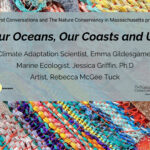 CATALYST CONVERSATIONS:
OUR OCEANS, OUR COASTS AND US
Friday, March 21, 6–7 pm ET
CATALYST CONVERSATIONS:
OUR OCEANS, OUR COASTS AND US
Friday, March 21, 6–7 pm ET
In March 2025, the Nature Conservancy of MA collaborated with Catalyst Conversations to present, “Our Oceans, Our Coasts and Us,” a thought-provoking event connecting art and science to explore addressing climate change along our coasts. Current TNC-CSI Postdoc Jessica Griffin was one of the event’s featured panelists. The panel featured short presentations and a powerful panel conversation to packed auditorium space in Cambridge’s Foundry space. The event recording is available in full on the event website at:
https://www.catalystconversations.org/upcoming-events-winter25
Author: CSI Staff