Tackling the problem of ocean plastics
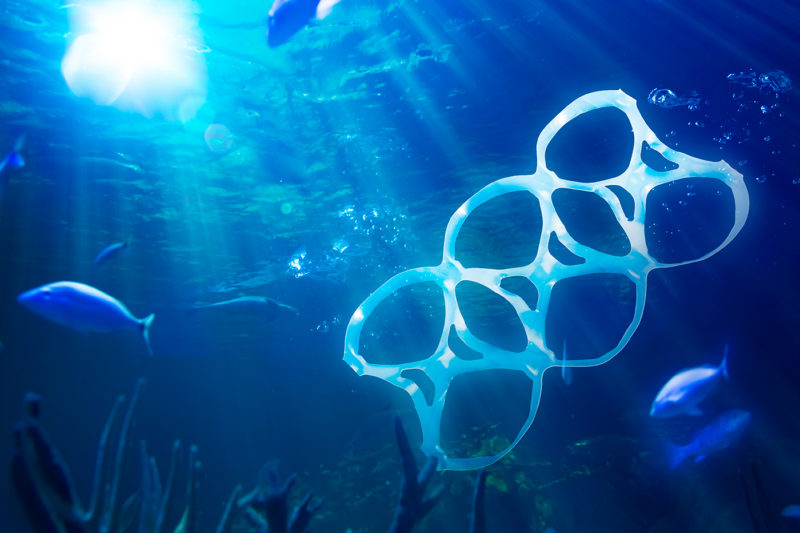
Plastics pollution is one of the greatest threats to our earth. CSI researchers, partners and alumni are working to understand the scale and impact of the plastics problem on ecosystems around the world.
Interdisciplinary Innovation at the Plastics Center: Dr. Aron Stubbins
Northeastern University has established a new Plastics Center co-directed by Maria Ivanova and Aron Stubbins to address the complex challenges of plastic use, waste, and regulation. Plastic pollution represents a significant potential threat to our environment and to human health: plastics have been found in human organs and in newborn babies, but there remains insufficient data on the actual harm they cause.
CSI Researcher Dr. Aron Stubbins, a professor of marine and environmental sciences, chemistry and chemical biology, and civil and environmental engineering, initiated the center by organizing conversations and workshops among Northeastern researchers from various disciplines to explore collaborative approaches to understanding and mitigating the environmental and health impacts of plastics while promoting safer alternatives. The Center seeks to explore the “plastics dilemma”—balancing the significant benefits of plastics (such as medical equipment, food preservation, and lighter airplane components) against serious downsides including persistent waste and potential health impacts from toxic additives leaching into food and water, and to reinforce the need for systemic change through policy interventions to ensure safer plastics are available in the marketplace.
Related News:
Plastics found to be abundant at deep-sea levels, new research reports
https://news.northeastern.edu/2025/05/01/ocean-plastics-deep-sea-levels-research/
Newly Founded Plastics Center Strives for Innovative Solutions to Plastic Waste
Tracking the Scale of the Problem: Dr. Mark Patterson and Ethan Edson, NEU ’18
An estimated 250 metric tons of microplastics—the remnants of water bottles and other plastic consumer goods—float in the world’s oceans. Taking research vessels out to study these particles and their dispersion patterns can be expensive and time-consuming. To change that, Northeastern marine-science student Ethan Edson worked with CSI professor Mark Patterson to invent a device to quickly collect and categorize microplastics.
Microplastics—shards that are each less than 5 millimeters long—degrade water quality, kill fish that consume them, and could potentially harm humans who ingest them via water or fish. Edson’s innovation, a sleek device called MantaRay, pumps seawater through its midsection, identifies microplastic particles, and sorts and stores them in filters. It includes GPS and sensors to track where the plastics are collected and the water temperature and salinity.
Edson’s prototype won a prestigious research prize at Northeastern, but he wanted to improve it and make it available to everyone, from seafood companies to environmental agencies. The Schmidt Family Foundation stepped in to help. Since 2016, the foundation has awarded Northeastern more than $250,000 to perfect and commercialize the prototype. Founded by tech executive Eric Schmidt and his wife, Wendy, the foundation advances the wiser use of energy and natural resources, and empowers communities to build resilient systems. Patterson and Edson also received business guidance and mentorship from professor Marc Meyer, an entrepreneurship expert based at Northeastern’s D’Amore-McKim School of Business.
Because of these partnerships, the MantaRay is slated to be on the market in 2019; it now includes advanced features like a satellite-based system that enables researchers to track microplastic amounts and patterns remotely for months, from anywhere on Earth.
“The MantaRay is an example of what great collaborations can create. We couldn’t have gotten the device to where it is today without help from the Schmidts or the entrepreneurial ecosystem at Northeastern,” Patterson says.
Author: CSI Staff